


How to Prepare for a Social Compliance Audit in the Food Sector

How to Prepare for a Social Compliance Audit in the Food Sector
This is the second in a series of articles considering the emerging requirements related to social compliance audits and broader ethical compliance expectations within the food supply chain.
In the article What is a Social Compliance Audit - Social Compliance Audits in the Food Sector – Expanding Ethical Compliance Requirements, the evolving expectations and requirements for social compliance audits as a condition of doing business with major retailers was presented. In an environment where social compliance audits in production facilities in the food supply chain, particularly in the United States, are the norm – preparing for those audits is key to a successful outcome.
From the outset, it is important to recognize that the objective should not be to “pass” the audit but to manage an operation that consistently meets requirements consistent with expectations – the expectations of direct customers, end customers and other interested stakeholders.
As with food safety – compliance with the social compliance standards and a positive audit outcome is the product of a systems based approach. This approach is grounded in understanding the requirements and establishing policies, procedures and controls to attain the requirements. In the context of larger compliance efforts – these core elements are affirmed though monitoring independent of the operation – essentially the social compliance audits performed to demonstrate performance to key stakeholders.
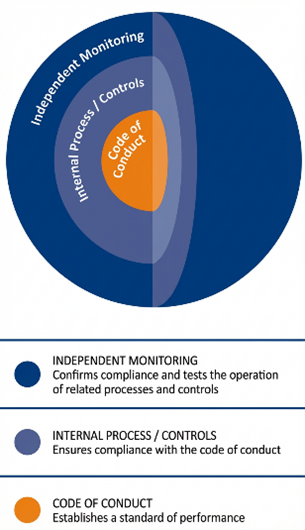
Understanding Requirements and the Social Compliance Audit Scope
An important consideration for any social compliance audit is ensuring the related requirements are well understood and addressed in preparation for the audit. While the core requirements of most social compliance program efforts – including the most common collaborative programs – are very similar, there are nuances to each program. The core requirements – outlined in the 10 categories presented in the article What is a Social Compliance Audit - Social Compliance Audits in the Food Sector – are generally tied to compliance with applicable local law and key international labor organization conventions.
While the standards are generally linked to compliance with related statutory requirements, there are elements where the standard establishes more restrictive expectations. The best example of this in the United States is compliance with standards on working hours. Most programs establish a requirement that workers do not, on a regularly scheduled basis, exceed 48 hours per week plus voluntary overtime, with a total maximum of 60 hours per week. In many countries, there are statutory maximum working hours that are below these thresholds. In the United States, there are no federal maximum working hours and therefore most companies do not have a system to limit hours consistent with the standard. For many companies in the US, this is an area where there is legal compliance but the standard of the code is not met and there is a reported non-conformance.
As with other compliance standards – particularly the larger collaborative programs – the standard holder provides guidance and implementation documents to support a proper understanding of the requirements associated with the program. Examples of these are:
- SMETA by SEDEX – https://www.eurofins.com/assurance/smeta-audit/
- Amfori BSCI – https://www.eurofins.com/assurance/amfori-bsci/
Beyond the program requirements and related nuances, in some cases, the entity to whom the audit is to be provided may also have nuanced requirements. These can include the specific audit scope – such as the SMETA 2 Pillar versus 4 Pillar scope; the audit scheduling and related windows; and the firms from whom the entity will accept an audit. These expectations are typically communicated by the entity for whom the audit is being executed and confirmed by the audit service provider.
Establishing and Confirming Internal Processes and Controls
The existence of management processes to meet requirements and the ability to demonstrate such processes both exist and are effective in meeting the requirements is the key objective of the social compliance audit. Similar to systems for Food Safety – these processes should be:
- Preventative – Ensuring the condition is met – avoiding non-compliance;
- Detective – Identifying, in a timely manner, instances where the condition is not met; and
- Corrective – Remediating identified instances where the condition is not met.
Consistent with the key elements in Food Safety, in order to provide evidence of the existence and operation of these processes – which supports providing evidence to an auditor -- the processes and controls should be:
- Documented – Documentation demonstrates the existence of policies and procedures – which is key to effective deployment of those elements. While there is no expectation that every small element of the compliance effort is presented in a compendium of policies and procedures - this is particularly important for key policies such as an Anti-Forced Labor policy and key procedures such as Disciplinary procedures
- Deployed – Moving from what is presented in documentation is key, effectively creating a reality in the facility consistent with the stated policies and procedures. In most cases, this includes identification of a specific individual/role responsible for the processes; and communication and training on the policies and procedures to ensure they are understood and can be followed. Implementing processes and controls – which logically including creating records of key elements to demonstrate performance.
- Monitored – Ensuring the processes and controls are working through on-going consideration of performance and related records.
The development and implementation of applicable processes and controls – most of which will already be in place in a well operated facility – will position the operation for a successful audit outcome.
Audit Organization and Engagement
With an understanding of the requirements and an established – more likely confirmed – set of processes and controls designed to ensure key requirements are properly considered and met, the operation is ready to organize the social compliance audit. With most program efforts – whether a collaborative program like SMETA and BSCI or a client centric program – there is a pre-audit questionnaire. In addition to providing important background information to facilitate the audit process, the questions can be used to infer requirements and provide a check that all key elements are considered and addressed.
With most programs, the operation will engage with the program owner and an audit service provider to organize the audit. Generally, social compliance audits are scheduled on a semi-announced basis – to be executed within an agreed window, typically 2 to 3 weeks. In both the organization of the audit and the selection of the audit service provider – it is critically important that any key customer requirements whether to the nature of the scheduling or the selected service provider align with key customer requirements. Having an audit that is not accepted, particularly by the entity for whom the audit was performed, is not positive and avoidable.
Audit Execution Preparation
In anticipation of the audit execution, there are several actions that will support a more efficient and effective audit intervention. Planning for the audit day – understanding that the actual day is not precisely known based on the ‘window scheduling’ is key to avoiding crises, and unnecessary scrambling for information and arrangements. In anticipation of the social compliance audit, in addition to the preaudit questionnaire, most audit service providers will engage the site and provide important information including:
- An audit schedule outlining the expected activities comprised in the audit execution. This is also one of the key elements of the opening meeting – typically the first activity on the audit day;
- Document request list outlining the key documents auditors will expect to review during the audit. With the exception of detailed records for testing for a control sample of workers – including such items as individual personnel files, time and wage records – most documentation including key policies and procedures, organization charts, records such as activity logs and information from suggestion boxes can be organized in advance.
Beyond the information identified by the audit service provider, the site can further enhance the efficiency of the audit by planning to include:
- Communication of the upcoming audit to applicable members of management team;
- Communication of the upcoming audit to any labor service providers for individuals who may be on site but are not directly employed by the site – an element of the population that is in scope and often a challenge;
- Communication of the upcoming audit to any worker representative as these individuals will be expected to participate in elements of the audit;
- Identification of a point of contact for the auditors during the time on site;
- Identification and organization of space for the auditor to work during audit day; and
- Identification and organization of space for the auditors to conduct confidential interviews with employees.
Proper organization and planning is key to minimizing issues and challenges during the limited time the auditors are on site and helps to make the entire experience more efficient and effective.
The social compliance audit is an element of the consideration of a site by customers and should be an opportunity for a site to demonstrate the commitment and consistent performance to ensure activities are completed under safe, lawful and humane working conditions. Through an understanding of expectations and requirements with a set of management processes designed to ensure the requirements are met – the audit is simply a brief on-site engagement to affirm performance and ideally minimize perceived risk associated with an operation which will logically reduce future interventions.
This article is the second in a series on Social Compliance Audits in the Food Sector. Future articles in this series will explore:
- Interpreting Audit Results – Reading a Social Compliance Audit Report;
- The Most Common Issues in Social Compliance Audits;
- Next Steps After a Social Compliance Audit;
- The Next Challenge for Food Manufacturers in the Social Compliance space
Our certification activities are provided by independent Certification Bodies, separately from any consulting activities. Impartiality is safeguarded by Eurofins Assurance’s relevant policies to avoid conflicts of interest.
Eurofins Assurance US
Risks reduced. Business enabled.


