


Advancements in STEC Detection: Historical Perspectives and Comparative Analysis of Testing Methods in Field and Culture Samples

Erica Miller, M.S., Chris Crowe, Ph.D., and John Scanga, Ph.D., Eurofins Rapid Microbiology Laboratories, Des Moines, IA, USA.
Research initially presented at BIFSCo, Fort Worth, TX; April 7-9, 2026.
Introduction/Background
Rapid and reliable detection of Shiga toxin–producing E. coli (STEC) is increasingly critical for food safety testing programs. Traditional culture-based confirmation remains the regulatory gold standard but requires multiple days to complete, delaying decision. As industry pressures demand faster turnaround times without compromising accuracy, molecular technologies—particularly qPCR and ddPCR—offer promising alternatives capable of reducing time-to-result while enhancing sensitivity in complex food matrices.
Objectives
To evaluate the USDA MLG workflow while comparing it to a potential molecular confirmation workflow for STEC detection following initial screening, with a focus on determining whether qPCR and ddPCR can:
- Reduce overall time-to-result
- Improve detection sensitivity
- Provide reliable confirmation for both field samples and cultured STEC isolates
Methods
Field samples (n=30), including trim and MicroTally™ cloths, were analyzed alongside reference STEC strains. All samples underwent initial STEC screening followed by molecular confirmation. Samples submitted to the study did not implicate product in commerce.
For the qPCR workflow, DNA was extracted using standardized protocols optimized for meat matrices. Initial STEC screening was performed using the Gold Standard Diagnostics STEC assay targeting stx1, stx2, and eae. Samples positive for stx1 and/or stx2 with eae present were further analyzed using BioMérieux’s PEC assay to detect espK and espV. Additional PCR screening was conducted to assess the presence of one or more Top 7 serogroups. Internal controls were included in all assays to monitor PCR inhibition, and cycle threshold (Ct) values were used to assess the presence and relative strength of detected gene targets.
The ddPCR workflow involved partitioning intact cells into thousands of nanoliter droplets, with each droplet containing zero or one bacterial cell. PCR amplification occurred independently within each droplet, and Bio-Rad’s dd-Check STEC kit was used to determine whether stx and eae were present together in the same bacterium. This droplet-level analysis enabled STEC confirmation through detection of target gene colocalization.
The cultural confirmation workflow was performed using Gold Standard Diagnostics immunomagnetic separation beads based on the detected serogroup. Following manufacturer instructions, sample beads were washed and plated onto modified Rainbow Agar (Biolog™) and CHROMagar STEC (CHROMagar™). Rainbow Agar plates were incubated for 22±2hours at 35°C, and CHROMagar STEC plates were incubated for 22±2hours at 37°C. After incubation, typical colonies were identified and confirmed using qPCR.
Results
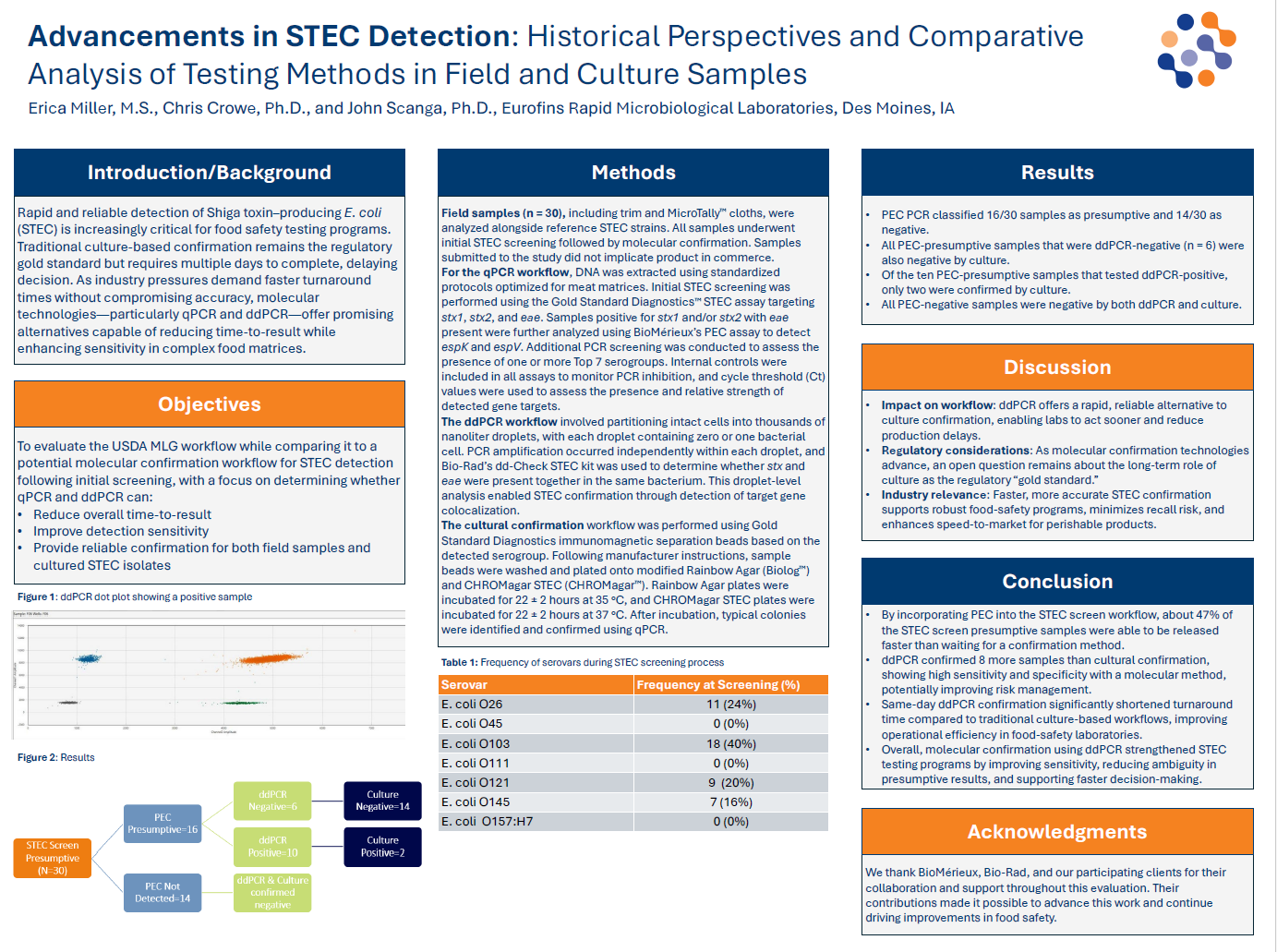
- PEC PCR classified 16/30 samples as presumptive and 14/30 as negative.
- All PEC-presumptive samples that were ddPCR-negative (n = 6) were also negative by culture.
- Of the ten PEC-presumptive samples that tested ddPCR-positive, only two were confirmed by culture.
- All PEC-negative samples were negative by both ddPCR and culture.
Discussion
- Impact on workflow: ddPCR offers a rapid, reliable alternative to culture confirmation, enabling labs to act sooner and reduce production delays.
- Regulatory considerations: As molecular confirmation technologies advance, an open question remains about the long-term role of culture as the regulatory “gold standard."
- Industry relevance: Faster, more accurate STEC confirmation supports robust food-safety programs, minimizes recall risk, and enhances speed-to-market for perishable products.
Conclusions
- By incorporating PEC into the STEC screen workflow, about 47% of the STEC screen presumptive samples were able to be released faster than waiting for a confirmation method.
- ddPCR confirmed 8 more samples than cultural confirmation, showing high sensitivity and specificity with a molecular method, potentially improving risk management.
- Same-day ddPCR confirmation significantly shortened turnaround time compared to traditional culture-based workflows, improving operational efficiency in food-safety laboratories.
- Overall, molecular confirmation using ddPCR strengthened STEC testing programs by improving sensitivity, reducing ambiguity in presumptive results, and supporting faster decision-making.
Acknowledgements
We thank BioMérieux, Bio-Rad, and our participating clients for their collaboration and support throughout this evaluation. Their contributions made it possible to advance this work and continue driving improvements in food safety.
View the poster
Questions on how this information is applicable to your food process?


