


Brian’s Beef: Food Safety IS an Economic Discussion—Let's Talk STECs

By Brian McFarlane
The beef industry continues to evaluate the balance between testing only for Escherichia coli O157:H7 and expanding testing to include the six major non‑O157 STEC strains (O26, O45, O103, O111, O121, and O145).
While USDA‑FSIS does not mandate testing programs, establishments are required to ensure their products are free from adulterants. Because the “Big 6” non‑O157 STEC strains are classified as adulterants, some processors have adopted expanded testing as part of their food safety systems, as of yet others have not.
In the beef industry, microbiological testing plays a critical role in both regulatory compliance and consumer protection. One of the most widely discussed issues is whether beef processors should test only for E. coli O157:H7 or adopt broader testing programs that include the STEC’s.
The White Elephant in the room - food safety IS an economic discussion, don’t let anyone fool you!
Let’s take STEC Testing as an example: Risk, Economics, and Regulatory Considerations. This topic often generates significant debate within the industry because it sits at the intersection of food safety, operational efficiency, and economics. While the regulatory framework is clear, the practical decisions surrounding testing strategies remain complex for many companies.
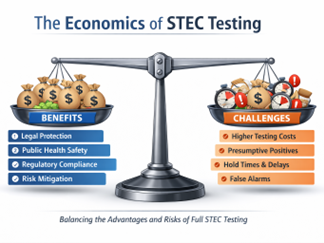
Expanded STEC testing offers stronger risk management and regulatory defensibility. Then there’s the debate on test methodology and added cost. Depending on the methodology used, it could increase laboratory costs, but not in all cases!
Ultimately, testing strategies should be evaluated as part of a broader risk‑management approach that considers regulatory expectations, public health protection, operational efficiency, and the potential financial impact of recalls. As you build your strategy, consider this:
- FSIS classifies O157:H7 and the “Big 6” STEC strains as adulterants in raw beef trimmings.
- Expanded STEC testing could increase laboratory costs but may reduce regulatory and recall risk.
- Presumptive positives remain a debate point in expanded testing programs.
- Advances in testing technologies are improving testing efficiency and reducing unnecessary product holds.
If you only test your product for O157 and you can support that your systems are performing and supplying the safest product possible, that is great. But if you're not 100% confident and you can’t support not testing for STECs with sound science and data, then here’s a few questions to consider:
- If you get more presumptives and longer product holds, is that inconvenience worth the risk and consumer safety?
- Imagine a scenario where a person falls ill due to a non-O157 strain and prosecuting legal team discovers that you could have been testing for all the STECs, how would that discussion unfold?
- If there was no additional cost to cover STECs, would your response be different?
- Could testing for STEC’s reduce recalls and reduce the risk of consumers from becoming ill?
Sincerely,
 Brian McFarlane – Director of Technical Services, Eurofins Rapid Microbiology Laboratories


