


Interventions to Achieve Pathogen Lethality Targets and Improve the Safety of Traditional Dried and Fermented Salami

John A. Scanga 1, John Henson 2, Juan A. Ascencio 3, Keith Belk 4
1 Eurofins Microbiology Laboratories, Lafayette, CO, USA. 2 Animal Sciences and Agricultural Education, California State Univerisity, Fresno, CA, USA. 3 Pricipe Foods, Columbia, MO, USA. 4 Center for Meat Safety and Quality, Fort Colins, CO, USA.
Rearch initially presented at 71st ICoMST, Girona, Catalonia, Spain; August 3-8, 2025.
Objective
Evaluate how antimicrobial interventions and high-pressure pasteurization improve the safety of dried and fermented ready-to-eat meats.
Introduction
Dried and fermented sausages are made from ground pork and contain salt, sodium nitrite/nitrate, fermenting starter cultures, and various spices. These products are marketed as ready-to-eat (RTE) and shelf-stable, but they often do not undergo sufficient processing to eliminate foodborne pathogens such as Salmonella spp. (SAL) and Listeria monocytogenes (LM). These pathogens can be present in raw meat and in the environment where processing occurs, and after lethality controls have been applied. Although fermented sausages are regarded as low-risk, outbreaks of SAL are linked to dried and fermented products worldwide [1,2]. Furthermore, LM continues to cause human foodborne illnesses and deaths related to ready-to-eat meat and deli products [3]. Current USDA-FSIS guidance requires manufacturers to validate that their process can reduce SAL 5 logs and LM by 3 logs [4].
Materials and Methods
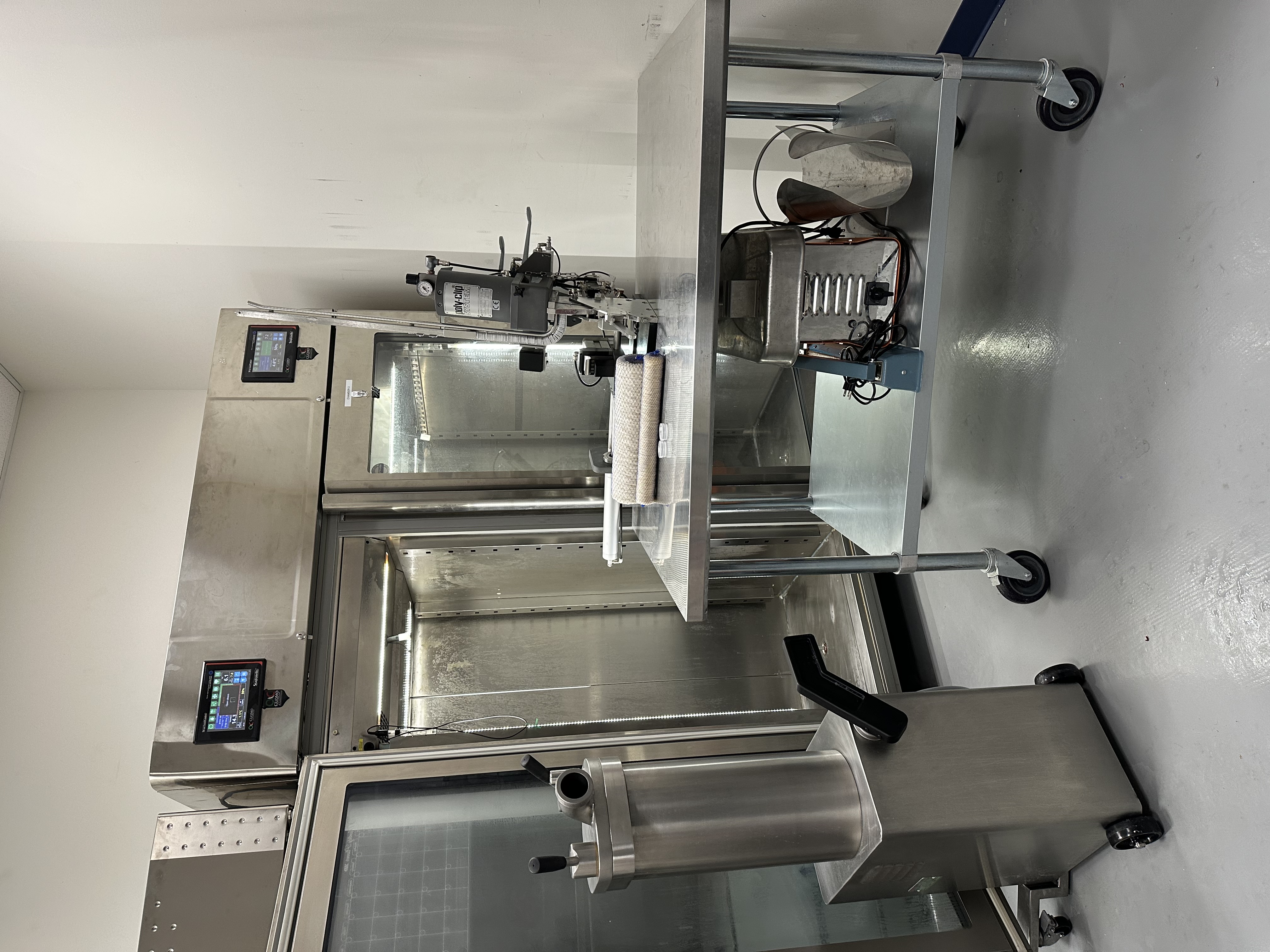 Four replicates of small (46mm) fermented, dried salami were produced: two with a raw antimicrobial intervention (LA) and two controls (CN). Pork raw materials (10kg pork inoculated with SAL or LM cocktails and sprayed with 2.5% lactic acid spray (LA); 20°C). Negative controls were inoculated but did not receive LA intervention. Inoculated raw materials were ground, seasoned (2.8% salt, 100 ppm NaNO2, 100 ppm NaNO3), stuffed into casings, fermented at 25-28°C and 90% RH, then dried and aged at 12-17°C and 70% RH until water activity dropped below 0.92. Inoculated 90mm and 105mm salami were produced without the use of antimicrobials. After drying, products were peeled, vacuum packaged, and subjected to high-pressure pasteurization (HPP) at 600 MPa for 3 minutes at 4°C. A consumer triangle test was conducted to compare a 46mm salami made with 5% LA-treated raw materials to negative controls.
Samples (25g; n=3 per replicate) for pathogen recovery were enumerated for SAL and LM and reported as log-transformed CFU per 25 g of sample, with a lower detection limit of 10 CFU/25 g.
Data were analyzed using JMP 18.1.1. Least squares means were calculated and separated with Tukey’s HDS at an alpha level of P < 0.05.
Results and Discussion
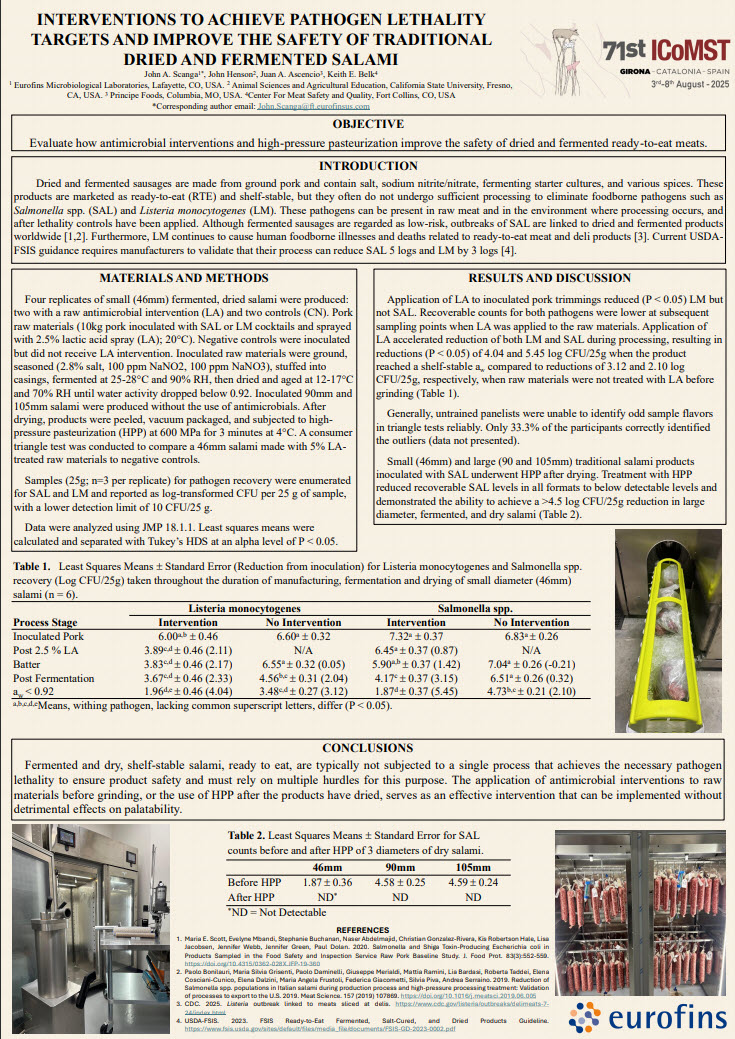
Application of LA to inoculated pork trimmings reduced (P < 0.05) LM but not SAL. Recoverable counts for both pathogens were lower at subsequent sampling points when LA was applied to the raw materials. Application of LA accelerated reduction of both LM and SAL during processing, resulting in reductions (P < 0.05) of 4.04 and 5.45 log CFU/25g when the product reached a shelf-stable aw compared to reductions of 3.12 and 2.10 log CFU/25g, respectively, when raw materials were not treated with LA before grinding (Table 1).
Table 1. Least Squares Means ± Standard Error (Reduction from inoculation) for Listeria monocytogenes and Salmonella spp. recovery (Log CFU/25g) taken throughout the duration of manufacturing, fermentation and drying of small diameter (46mm) salami (n = 6).

Generally, untrained panelists were unable to identify odd sample flavors in triangle tests reliably. Only 33.3% of the participants correctly identified the outliers (data not presented).
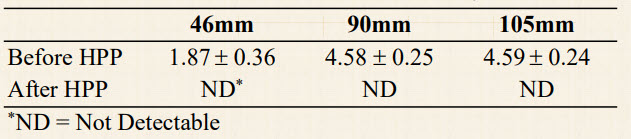
Small (46mm) and large (90 and 105mm) traditional salami products inoculated with SAL underwent HPP after drying. Treatment with HPP reduced recoverable SAL levels in all formats to below detectable levels and demonstrated the ability to achieve a >4.5 log CFU/25g reduction in large diameter, fermented, and dry salami (Table 2).
Table 2. Least Squares Means ± Standard Error for SAL counts before and after HPP of 3 diameters of dry salami.
Conclusions
Fermented and dry, shelf-stable salami, ready to eat, are typically not subjected to a single process that achieves the necessary pathogen lethality to ensure product safety and must rely on multiple hurdles for this purpose. The application of antimicrobial interventions to raw materials before grinding, or the use of HPP after the products have dried, serves as an effective intervention that can be implemented without detrimental effects on palatability.
References
- Maria E. Scott, Evelyne Mbandi, Stephanie Buchanan, Naser Abdelmajid, Christian Gonzalez-Rivera, Kis Robertson Hale, Lisa Jacobsen, Jennifer Webb, Jennifer Green, Paul Dolan. 2020. Salmonella and Shiga Toxin-Producing Escherichia coli in Products Sampled in the Food Safety and Inspection Service Raw Pork Baseline Study. J. Food Prot. 83(3):552-559. https://doi.org/10.4315/0362-028X.JFP-19-360
- Paolo Bonilauri, Maria Silvia Grisenti, Paolo Daminelli, Giuseppe Merialdi, Mattia Ramini, Lia Bardasi, Roberta Taddei, Elena Cosciani-Cunico, Elena Dalzini, Maria Angela Frustoli, Federica Giacometti, Silvia Piva, Andrea Serraino. 2019. Reduction of Salmonella spp. populations in Italian salami during production process and high-pressure processing treatment: Validation of processes to export to the U.S. 2019. Meat Science. 157 (2019) 107869. https://doi.org/10.1016/j.meatsci.2019.06.005
- CDC. 2025. Listeria outbreak linked to meats sliced at delis. https://www.cdc.gov/listeria/outbreaks/delimeats-7-24/index.html
- USDA-FSIS. 2023. FSIS Ready-to-Eat Fermented, Salt-Cured, and Dried Products Guideline.
https://www.fsis.usda.gov/sites/default/files/media_file/documents/FSIS-GD-2023-0002.pdf
View the poster
Questions on how this information is applicable to your food process?


